VieLight Therapy
Available at Bounce Matters · Manly, Sydney
Recharge your brain with near-infrared light. Non-invasive photobiomodulation backed by 30+ published studies from leading universities worldwide.
What Is VieLight Therapy?
VieLight Therapy is a form of photobiomodulation (PBM) that uses low-level near-infrared (NIR) light to support your brain at the cellular level. The devices deliver precisely calibrated 810nm wavelength light through the scalp and nasal cavity, reaching the brain's cortical tissue where it interacts with the mitochondria – the energy centres of your cells.
This is not a fringe technology. VieLight devices are the most clinically studied transcranial photobiomodulation devices in the world, with over 30 published peer-reviewed studies conducted by universities including UCSF, the University of Toronto, the University of Utah, the University of Sydney, Harvard, and Boston University.
At Bounce Matters, Jo Grabyn is one of only a small number of Australian practitioners offering VieLight Therapy as part of a comprehensive brain health program. VieLight can be used in-clinic or purchased for ongoing home use as part of your personalised care plan.
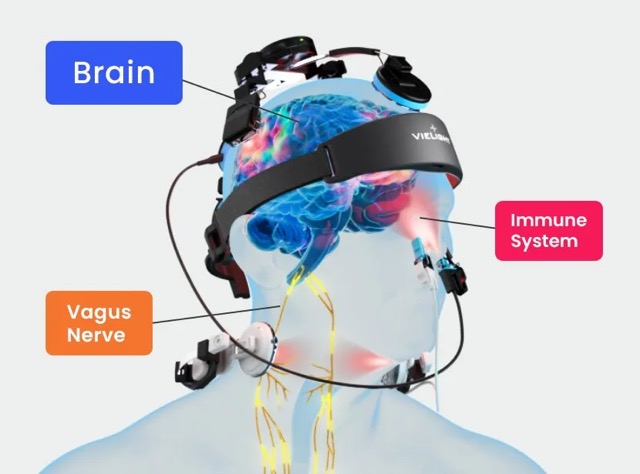
How Photobiomodulation Works
Photobiomodulation is the process by which specific wavelengths of light interact with biological tissue to support normal cellular function. Here is what the published research describes:
Light Reaches the Brain
Near-infrared light at 810nm passes through the scalp and skull. The nasal applicator delivers light via the thin nasal tissue, providing direct access to deeper brain structures including the ventral prefrontal cortex.
Cytochrome C Oxidase Absorption
The photons are absorbed by cytochrome c oxidase (CCO), an enzyme in the mitochondrial electron transport chain. CCO is the primary photoacceptor for near-infrared wavelengths in the 700–980nm range.
Nitric Oxide Dissociation
The absorbed light energy dissociates inhibitory nitric oxide (NO) from the CCO binding site. When NO is bound, it competes with oxygen and slows energy production. Releasing it restores normal mitochondrial respiration.
Increased ATP Production
With NO cleared, the electron transport chain operates more efficiently – increasing mitochondrial membrane potential, oxygen consumption, and the production of adenosine triphosphate (ATP), the cell's primary energy currency.
Downstream Cellular Effects
Published research describes downstream effects including improved cerebral blood flow, modulation of reactive oxygen species, and support for neural connectivity and brain network efficiency.
What the Published Research Shows
VieLight is the most published photobiomodulation technology in the world. These are findings from peer-reviewed studies conducted at independent universities – not manufacturer claims.
Improved Cognitive Scores and Brain Connectivity
Participants with mild-to-moderate Alzheimer's showed improved ADAS-cog scores, increased cerebral perfusion, and stronger default-mode network connectivity after transcranial and intranasal PBM.
Chao et al., 2019 – UCSF (University of California San Francisco)
Cognitive, Metabolic and Biomarker Improvements
After six weeks of treatment, participants with MCI showed improvements in cognitive performance, brain connectivity, and mitochondrial function, along with favourable changes in blood biomarkers linked to Alzheimer's.
University of Toronto & St. Michael's Hospital, 2026
Measurable Cognitive Assessment Gains
Montreal Cognitive Assessment scores increased by 3.20 points in the active group versus 1.97 with placebo after 60 days of photobiomodulation, in a double-blind, sham-controlled trial.
Neda et al., 2024 – Published in Alzheimer's & Dementia
Reaction Time and Balance in Contact Athletes
In NCAA contact sport athletes, reaction time showed a large effect size (g = 0.75) and reactive balance (MiniBEST) improved with g = 0.63 relative to baseline following transcranial PBM.
Johnson et al., 2024 – University of Utah / BYU, published in Journal of Neurotrauma
$4.6M US Department of Defense Research Grant
The US Department of Defense awarded a $4.6 million grant for VieLight TBI neuroprotection research, reflecting the significance of the technology's potential in traumatic brain injury recovery.
US DoD Research Grant – University of Utah collaboration
Improved Mobility Instead of Expected Decline
Participants showed improved mobility and cognition rather than the typical decline expected over time. 10-metre walking speed rose from 1.12 to 1.70 m/s after 12 weeks – approximately 50% faster.
Liebert et al., 2021 – University of Sydney
Enhanced Neural Connectivity and Efficiency
PBM boosted global network efficiency in alpha and gamma bands across up to approximately 90% of tested connectivity densities, with no such changes under sham conditions.
Zomorrodi et al., 2019 – Published in Nature Scientific Reports
Improved Creativity Scores
Creativity scores improved with a large effect size compared with sham stimulation, indicating stronger idea fluency and originality following transcranial PBM over the default mode network.
Peña et al., 2024
Research collaborations include UCSF, Harvard University, University of Toronto, University of Utah, University of Sydney, Boston University, University of Pennsylvania, UCLA, and the University of Alberta. For the full list, visit vielight.com/research.
Who May Benefit from VieLight Therapy?
VieLight Therapy is used by a wide range of people. While individual outcomes vary, the following groups have been the focus of published clinical research:
What to Expect
In-Clinic Sessions
At Bounce Matters, VieLight Therapy is available as part of your comprehensive brain health program. A typical session takes 20 minutes. You sit comfortably while wearing the VieLight headset and intranasal applicator – there is no discomfort, no downtime, and no medication involved.
Jo will recommend a session frequency based on your individual assessment. Most protocols in the published research used sessions three to six times per week over periods of six to twelve weeks.
Home Use
One of VieLight's greatest strengths is that the devices are designed for ongoing home use. As one of a small number of authorised Australian distributors, Bounce Matters can supply VieLight devices directly. Jo provides guidance on which device suits your needs and how to integrate it into your care plan.
VieLight Devices Available Through Bounce Matters
All prices are in USD and will be converted to AUD at time of purchase. To purchase a device, contact us.
Neuro Gamma 4
USD $1,799
40Hz gamma frequency. Researched in Alzheimer's and cognitive enhancement studies. Transcranial and intranasal delivery.
Neuro Alpha 4
USD $1,799
10Hz alpha frequency. Researched in mood, relaxation, and default mode network studies. Transcranial and intranasal delivery.
Neuro Duo 4
USD $2,399
Both Gamma and Alpha modules in one package. For those who want the flexibility of both frequency options.
VieLight Vagus
USD $699
Targets the vagus nerve via auricular and intranasal photobiomodulation. Researched for systemic and autonomic nervous system support.
Safety Information
VieLight Therapy is non-invasive and does not involve medication, heat, or radiation in the ionising range. The devices have received medical device licences in multiple jurisdictions. However, there are important contraindications:
Contraindications
- Active brain bleeds or haemorrhagic conditions – PBM should not be used during active intracranial bleeding
- History of seizures or epilepsy – the pulsed light frequencies may not be suitable; discuss with your practitioner
- Pregnancy – insufficient research exists on PBM use during pregnancy
- Photosensitive medications – some medications increase light sensitivity; disclose all current medications during your consultation
Jo Grabyn will assess your suitability for VieLight Therapy as part of your initial consultation. This assessment is a standard part of the Bounce Matters approach – we never recommend a therapy without understanding your full clinical picture first.
Why VieLight Therapy at Bounce Matters?
VieLight Therapy is not a standalone treatment at Bounce Matters. It sits within a comprehensive, evidence-informed brain health program led by Jo Grabyn – a certified Bredesen ReCODE practitioner, nutritional medicine specialist, and one of Australia's most experienced clinical practitioners in brain health and cognitive recovery.
That means your VieLight sessions are part of a broader strategy that may include functional pathology testing, nutritional and lifestyle interventions, and ongoing clinical monitoring. You are not buying a device and hoping for the best – you are working with a practitioner who understands the research, knows the contraindications, and tailors every recommendation to your individual situation.
This is the Bounce Matters difference: cutting-edge technology integrated into whole-person care.
The information on this page is for educational purposes only and is not intended as medical advice. VieLight Therapy is a complementary modality and should not replace conventional medical care. The research cited reflects findings from published peer-reviewed studies; individual results may vary. VieLight devices are not listed on the Australian Register of Therapeutic Goods (ARTG) as therapeutic devices for the treatment of specific conditions. Always consult a qualified healthcare practitioner before beginning any new therapy.
Ready to Learn More About VieLight Therapy?
Book a complimentary 15-minute discovery call with Jo Grabyn to discuss whether VieLight Therapy may be appropriate for your situation.